
Opinion 22: Data Centres
An Architectural Opportunity
By Ebony Willis
In the late nineteenth century, Melbourne was known as Marvellous Melbourne. It stood beside London, Paris, and New York as a city of ambition and confidence. The Gold Rush created wealth and optimism. It drew migrants, entrepreneurs, and dreamers who wanted to build a new kind of city at the edge of the world. Writers such as Graeme Davison and Kristin Otto describe this moment as one of civic pride. The grand hotels, theatres, and arcades were not built from necessity. They were built to express belief in progress and collective identity. The Federal Coffee Palace, for instance, was a private building designed as a public statement. It celebrated prosperity and sophistication. Architecture gave Melbourne a sense of global belonging. That confidence did not last. The crash of the 1890s, followed by cycles of boom and bust, left many buildings in disrepair. By the mid twentieth century, much of the city’s heritage was undervalued. The film The Lost City of Melbourne captures this decline. It shows how ornate buildings were destroyed during the “wrecking era,” replaced with car parks and glass towers. What was lost was not only architecture but imagination. The civic spirit that once shaped the city gave way to efficiency and anonymity. Today, Melbourne stands at another turning point. The rapid growth of artificial intelligence, cloud computing, and digital networks demands a new kind of infrastructure. Data centres now hold the systems that manage our daily lives. They are the power stations of the information age. Yet their presence is hidden. They sit at the city’s edge, silent and opaque. Once again, Melbourne risks repeating its history of erasure, replacing vision with utility.


Infrastructure is not neutral. It reflects the values of a society and shapes how people live together. The Pompidou Centre in Paris is more than a technical achievement. It exposes its structure, colour, and circulation, transforming what is usually hidden into a public statement. It embodies the idea that technology can be transparent, that function can be expressive. Melbourne once understood this. Its nineteenth century buildings declared a sense of purpose. They combined engineering and artistry, function and pride. The bridges, post offices, and theatres were civic symbols. They showed that architecture could unite the practical and the poetic. Today’s data centres could play a similar role. Yet most are treated as industrial warehouses, designed for efficiency rather than meaning. Their guarded nature reflects a culture that conceals the mechanisms of technology. This invisibility is intentional and reveals a mindset that prefers control to openness. These buildings already define how we live. They store our memories, process our movements, and manage our communication. They are the true monuments of our time. To hide them is to deny that the digital is part of public life. Architecture can challenge this. It can make visible what has become invisible. It can turn private systems into civic expressions. Giving data centres a civic form would signal ownership. It would declare that the digital world belongs to people, not only corporations. This would be a political act as much as a design gesture. Transparency can build trust where secrecy breeds fear.

The story of the lost city is a warning. Melbourne once destroyed the very symbols that gave it cultural identity. Theatres, arcades, and public halls were replaced by blank towers. Progress was confused with demolition. Among the casualties was the grand Federal Coffee Palace, a landmark of civic ambition and social life. After its demolition, the site was developed with office buildings, including Enterprise House, which was later replaced by new development. Its loss marked more than the disappearance of a building. It symbolised a shift in values. The loss was not just aesthetic. It was social. Architecture had once been a shared experience. People gathered in theatres, libraries, and streets that represented civic life. When those spaces vanished, so did a sense of belonging. The challenge now is not to restore what was lost, but to reinterpret its spirit. Restoring the past is impossible. Contexts change, and so do meanings. The architecture of the future must engage with contemporary needs. Melbourne’s digital infrastructure offers a chance to rebuild civic identity in a new way. Data centres could be visible, expressive, and connected to their surroundings. They could include public programs such as exhibitions or learning spaces. They could show how energy flows, how networks operate, and how data shapes society. This would continue the city’s tradition of innovation. Melbourne has always been a place of adaptation and reuse. Old warehouses become galleries. Factories become creative studios. The same approach can turn invisible technology into visible culture.
Fowler, L., Commercial Photographic Co., photographer, & Vivian, T. & S. architects. (1937). “Padua Theatre, Brunswick, operated by Hoyts Theatres.”
Architecture has always revealed what a culture values. In the nineteenth century, Melbourne’s architecture showed ambition. In the twentieth, it reflected efficiency and commerce. In the twenty first, it will reveal our relationship with information. The cultural image of data is often dystopian. Popular films like WarGames, The Matrix, and Severance depict data centres as cold machines or places of control. Endless corridors, blinking lights, and security fences have become the visual language of the digital age. These images influence how people think about technology. They make it appear abstract, secretive, and inhuman. Architecture can challenge this image. It can turn suspicion into curiosity. It can make technology visible, tactile, and civic. Just as libraries made private archives public, data centres can transform hidden systems into shared spaces. This shift echoes Rem Koolhaas’s idea of Bigness. In his essay, Koolhaas argues that large buildings reflect the scale and ambition of their time. They embody change. A data centre is a building of great size and consequence. If designed well, it can become a new form of monument. Not a monument of power, but of participation. To design such architecture requires imagination. It means seeing data not only as code but as culture. The flows of information can be represented through light, structure, and form. A façade could reveal the rhythm of activity inside. They could display the pulse of the network; they could connect digital systems with daily life.
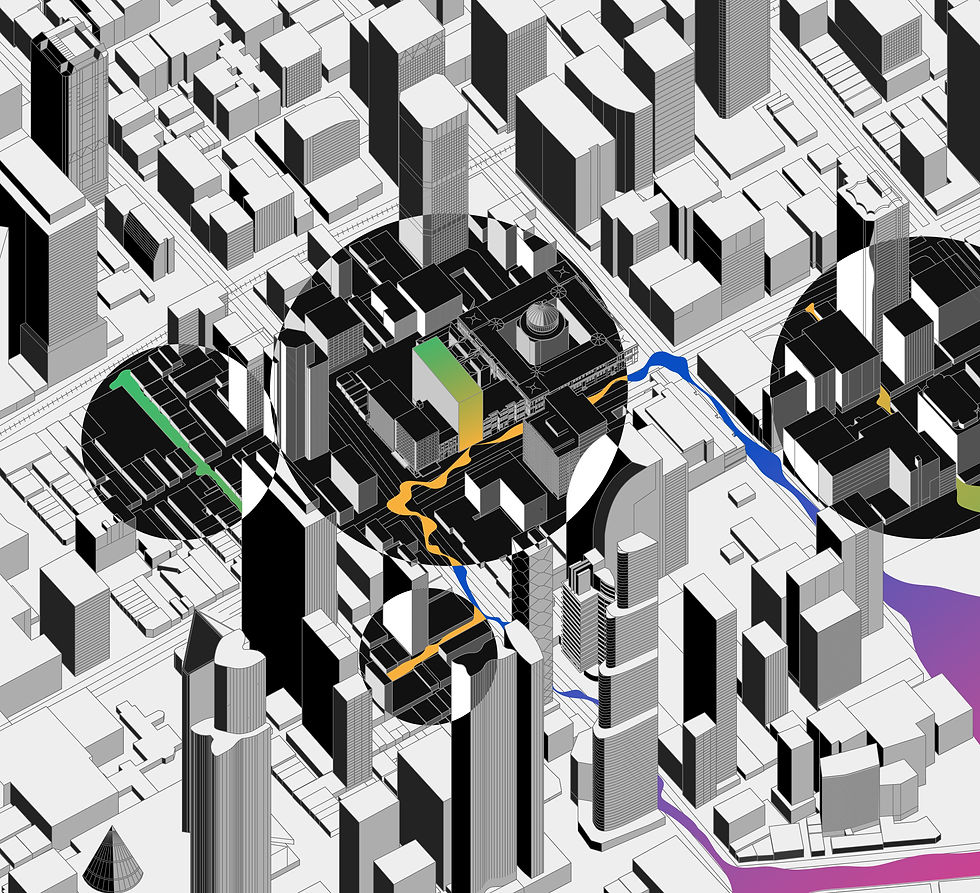
Public life no longer takes place only in streets and squares. It also happens on screens. Social media platforms have become new public spaces, though they are privately owned. This shift raises difficult questions. What does a civic building mean when social connection happens online? What is the role of architecture in a digital democracy? Melbourne is well placed to lead this discussion. The city has a long history of experimentation. Its creative industries, universities, and research institutions are global in scope. It is a city that values design thinking. Data centres could become part of that civic network, hosting public spaces that combine culture and technology. They might use waste heat to power nearby buildings or display real-time information about energy use. Through design, systems can be connected to citizens. The former Telephone Exchange on Lonsdale Street, now collecting dust, is one such opportunity, a relic of analogue communication that could be reimagined for the digital age. Reviving buildings like this would continue Melbourne’s legacy of civic ambition and express a renewed faith in design as a social force. Instead of hiding technology, they would celebrate it as part of urban life.
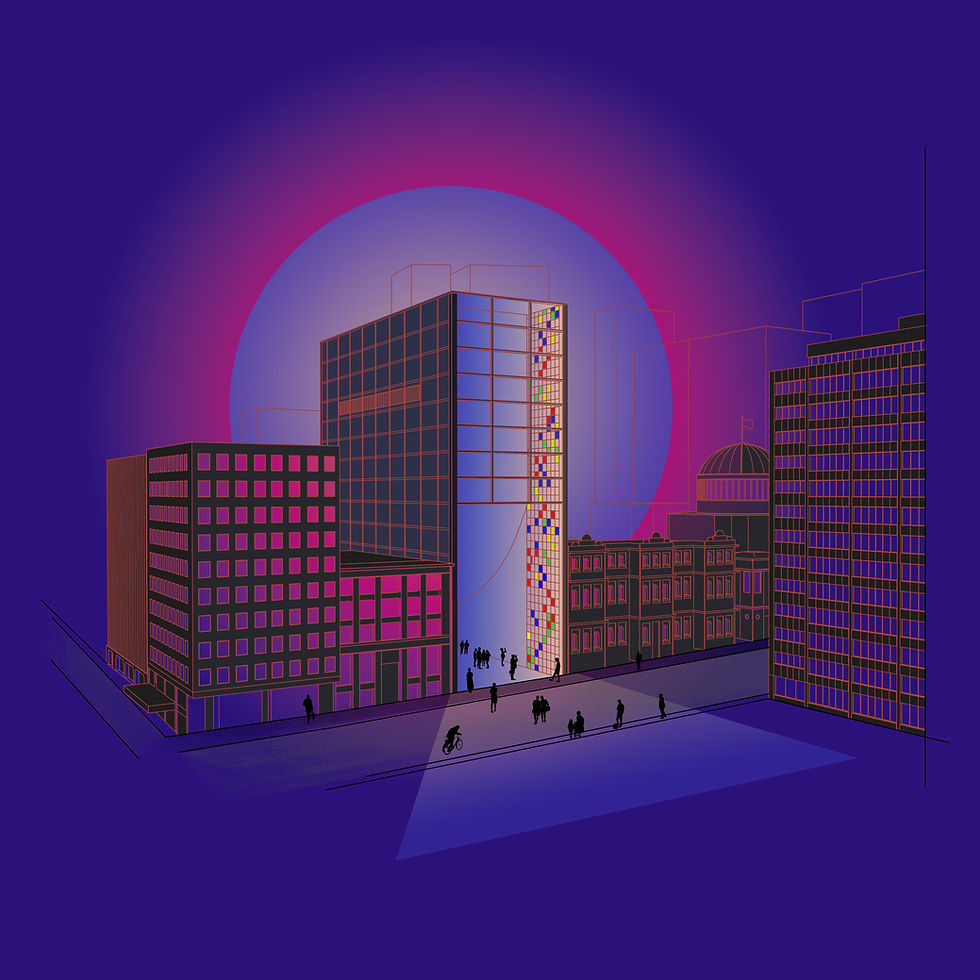
Visibility is not only an aesthetic choice but an ethical one. When infrastructure is hidden, questions of power and ownership disappear from public debate. Who controls data? Who benefits from it? Where does it go? These are civic questions, and architecture can make them visible. Melbourne brands itself as a knowledge city, with an economy built on education, research, and creativity. Data infrastructure belongs to that same ecosystem. By giving it architectural form, the city can align technology with its cultural values. This idea is already emerging in global practice. Grimshaw Architects’ 2025 Venice Biennale project Data Centres and the City reframes data infrastructure as civic architecture. Their model maps flows of energy, water, and human activity, treating data as a shared resource rather than a secret commodity. This is the kind of thinking Melbourne can adopt. The data centre of the future may stand alongside the library or the gallery, serving both technical and social functions. It would remind people that information, like water or electricity, is a public utility.
![Grimshaw Architects. (2025). Data Centres and the City [Photograph of exhibition model]. Grimshaw Architects.](https://static.wixstatic.com/media/6a6713_eefe85120ef949d29e457b255eff6159~mv2.jpg/v1/fill/w_980,h_654,al_c,q_85,usm_0.66_1.00_0.01,enc_avif,quality_auto/6a6713_eefe85120ef949d29e457b255eff6159~mv2.jpg)
This is a call for architects, artists, and designers. Engineers can make data centres efficient. Developers can make them profitable. But only design can make them meaningful. Architecture gives form to collective belief. It connects the technical to the emotional. It shapes how a society imagines itself. The design of data centres will define how we experience the digital world as something private and alien, or civic and shared. Melbourne once lost its architectural soul through demolition. It must not lose it again through invisibility. To hide the architecture of data is to deny that the digital is part of our culture. If we choose visibility, we can reclaim imagination. Data centres could become the cathedrals of the information age, not in scale or grandeur, but in purpose. They could be places of connection, curiosity, and collective identity. This is the opportunity before us. To design for transparency. To transform infrastructure into culture. To make Melbourne once again a city that leads through imagination. The question is not whether we will build them, but what story they will tell.
-
References:
Davison, G. (1978). The rise and fall of Marvellous Melbourne. Melbourne University Press.
Grimshaw Architects. (2025). Data centres and the city: From problem to solution on the path to sustainable urbanism. Venice Biennale, 19th
International Architecture Exhibition. Retrieved from https://www.datacentrecommunities.com
Koolhaas, R. (1995). Bigness or the problem of large. In S, M, L, XL (pp. 495–516). Monacelli Press.
Otto, K. (2005). Capital: Melbourne when it was the capital city of Australia. Text Publishing.
Wilson, G. (Director). (2023). The lost city of Melbourne [Film]. Ghost Pictures.
Boyan Zhao, Rui Hou, Jianbo Dong, Huang, M., Mckee, S. A., Qianlong Zhang, Yueji Liu, Ye Li, Lixin Zhang, & Dan
Meng. (2019). Venice: An Effective Resource Sharing Architecture for Data Center Servers. ACM Transactions on Computer Systems, 36(1), 1–26. https://doi.org/10.1145/3310360
Bratton-Benfield, I. (2023). Strategic visibility: architectures of data colonialism in Las Vegas. Journal of Visual Culture, 22(1), 47–63. https://doi.org/10.1177/14704129231161952
Fok, W. W. (2023). Hidden Infrastructures: From “Spy‐Hubs” to Hollow Buildings that Conceal the New Digital. Architectural Design, 93(6), 30–37. https://doi.org/10.1002/ad.2991
Jacobson, K., & Hogan, M. (2019). Retrofitted data centres: A new world in the shell of the old. Work Organisation, Labour & Globalisation, 13(2), 78-94.
Johnson, A. (2019). Emplacing data within imperial histories: imagining Iceland as data centers’‘natural’home. Culture Machine, 18(5), 1-12.
Koolhaas, R. (2019). Museum in the Countryside: Aesthetics of the Data Centre. Architectural Design, 89(1), 60–65. https://doi.org/10.1002/ad.2390
Levenda, A. M., & Mahmoudi, D. (2019). Silicon forest and server farms: The (urban) nature of digital capitalism in the Pacific northwest. Culture Machine, 18, 1-14.
Sadowski, J. (2020). The Internet of Landlords: Digital Platforms and New Mechanisms of Rentier Capitalism. Antipode, 52(2), 562–580. https://doi.
org/10.1111/anti.12595
Taylor, A. R. E. (2021). Future‐proof: bunkered data centres and the selling of ultra‐secure cloud storage. Journal of the
Royal Anthropological Institute, 27, 76–94. https://doi.org/10.1111/1467-9655.13481
-
Ebony Willis is an Australian architectural designer based in Melbourne and a final semester Master of Architecture student at Swinburne University. Her work explores the relationship between architecture, society, and technology, focusing on how the built environment can respond to changing cultural and environmental conditions. Ebony’s research and design interests centre on the societal discourse surrounding the future of architecture, particularly how innovation, artificial intelligence, and new materials are transforming the role of the architect.


Comments