
Opinion 20: Architectural Inheritance
By Connor Harris
Edmond and Corrigan's architectural language of pluralism and eclecticism is one that has been passed down through a large Melbournian architectural student family tree. Level one of the Design Hub practically tells the story; in a particularly muted and cold building a large splash of colour with a graphic that reads "Mother Knows!" can be found in stark juxtaposition to Godsell's Design Hub. A fitting reference to the influence that was and is Edmond and Corrigan. In reflecting on one's own design practice in 0conjunction with a broader discourse of like-minded emerging architects and their own developing practices, it becomes obvious that this language of pluralism and the art of referencing or appropriation is still very much thriving.
The influence that Edmond and Corrigan's practice has had on the Melbourne architectural scene is not in dispute. It is without a doubt that Edmond & Corrigan's influence on current RMIT students is just as prevalent as before, even without the first hand teachings from Peter himself. Whether the influence manifests in forms of inspiration, provocation or for some, annoyance; students still feel this influence regardless. Eclecticism and referencing, 'borrowing' or appropriation are some of the critical design languages that I believe have been passed on through architectural practice. So what is the value of referencing or appropriation as a design tool within architectural practice? First, before outlining some of the Melbournian architectural discourse of referencing and appropriation, I think it would be useful to define how I am implementing the terms. Here I use both appropriation and referencing interchangeably where they are both defined as the practice of using pre-existing objects, both architectural and non-architectural objects, in one’s own work.

Implementing references in projects as a design tool was an aspect that was integral to Edmond and Corrigan's design practice. From forms that speak to the Australian architectural vernacular of houses and churches, to iconography that conveys ideas about Australian identity, Edmond and Corrigan are no strangers to referencing as a design tool. RMIT's Building 8 is perhaps the best and most well known example to observe. Standing tall on Swanston Street as a collage of colour, patterns, bay windows and turrets, it is a building that fills me with joy; every time I look at it I seem to find a new fascination in its details. Love it or hate it, Building 8 has had a dramatic effect on a large body of students and practitioners to be hailed as an icon of Melbourne's built environment. Building 8 looms over RMIT's city campus as a castle, with two turrets either side of the building, bay windows overlooking the street, topped with a built-in flag to the right, always flying high at full mast. Its interiors are a stunning collection of beautifully considered handrail details and colorful tile patterns. Some of the tiles used on each level, as is widely known, represent some of the different Australian Rules Football team colours. Perhaps my favourite reference in Building 8 is tucked away in the corner where a lone column stands tall facing Rodda Lane. The column happens to be the spitting image of Constantin Brâncuși's 'Gate of the Kiss'. The design language of references in Building 8 speaks to ideas of culture and identity, each reference acting as a signifier of an idea.
In the same manner, Edmond and Corrigan's use of cultural iconography, referencing and appropriation is a language of design that has been implemented by other Melbournian architectural practices, the most notable and memorable, perhaps also the most outlandish and provocative is Ashton Raggatt McDougall. Many of ARM's projects utilise referencing and appropriation to some degree as a design tool. Yet, unlike some of the Edmond and Corrigan examples, it seems as though ARM have nothing to hide in their use of appropriation as a design tool. With each project they leave behind a trail of crumbs-of-appropriation to be followed, although I doubt you’d even need the crumbs to solve the mysteries and find where they’ve left behind a reference or two… or 49.
The Kronborg Health Clinic is Vanna Venturi House, stretched and warped by a printer’s photocopier. Storey Hall contains an element with striking resemblance to the Vault/Yellow Peril, among a large collection of smaller references throughout the building. ARM has even appropriated the cardboard box; the Melbourne Recital Centre's facade represents a piece of Styrofoam being pulled out of its cardboard box, on the west facade you can admire the graphic for the contents of the box: the section of the Elizabeth Murdoch Hall, the product you come for when you visit the centre. The Australian Institute of Aboriginal and Torres Strait Islander Studies is the black Villa Savoye, inverted in form and colour.
The list goes on and I have limited words.
Similarly Denton Corker Marshall are also known for having used referencing as a design tool. The Melbourne Museum references the Rubik's cube, an icon of childhood and play, fitting for the Children's Gallery section of the museum. I think you get the idea; appropriation and referencing as design tools certainly are used beyond the scope of Edmond and Corrigan's own work; I believe it speaks immensely to their influence on the city of Melbourne, and Australian architectural discourse.
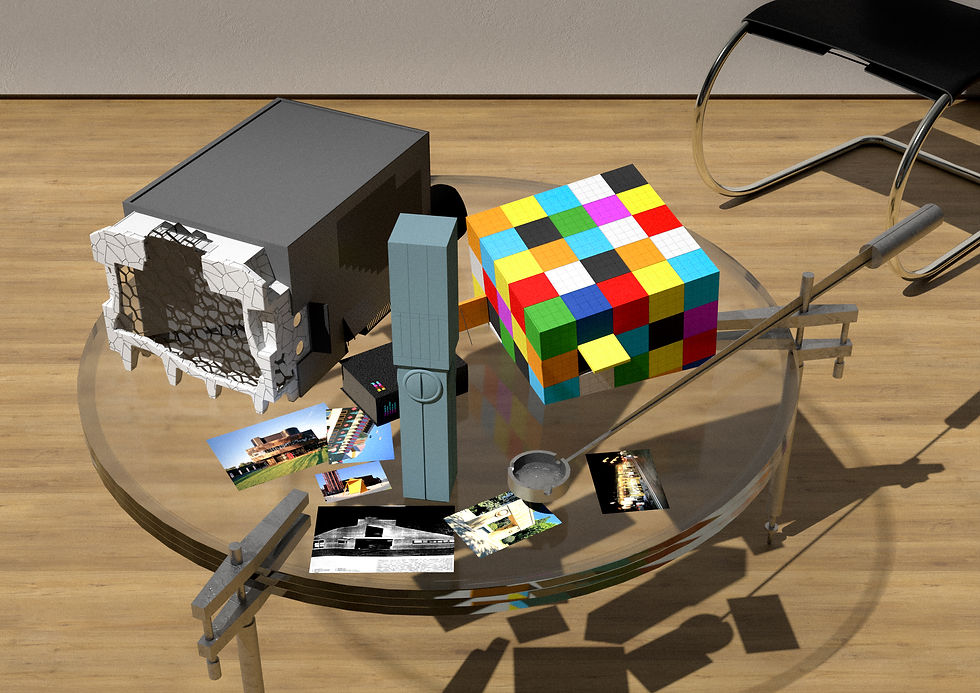
So what about us? The students. Where do we sit amongst such rich discourse of Australian architecture?
Without a doubt Corrigan's years spent teaching at RMIT have shaped how we now experience studios and studio culture at RMIT. Corrigan's pedagogical methodologies have left behind a trail of studios that engage with politics, theory, ethics and culture at all levels. Edmond and Corrigan's influence on Melbourne through their eclectic and plural architectural language has not escaped the students. Students are not strangers to the same design methodology of referencing and appropriation.

When speaking to Felix Tie, a Bachelor student at RMIT, he proclaimed that “finding references is the second step in any design process that uses time, context, or culture as its first step” and that “to avoid references is ignorant; to not realize you are using them is naive. Appropriation, as a subset of referencing, is again unavoidable, as the term encompasses everything from theft to homage”.
I feel that this leaves us in a predicament, one where it becomes unclear as to whether appropriation and referencing exist at the subconscious level and are inevitable or if they play an active role in the design process at the level of decision making. Nevertheless, are referencing and appropriation useful design tools, whether subconscious or not? It could be said that appropriation as a design tool is no more than pedagogical shorthand in achieving a specific architectural or design language within a project. In this context appropriation becomes a way to rapidly codify one’s work and place it within a broader sphere of thought experimentation and architectural discourse.
With all this being said, I believe that it is of the utmost importance to recognise references, subconscious or not, in your own work. Whilst useful as a design tool for codifying a project, in reality it cannot become the focus of the project or play any larger role than a design agitator or sneaky homage. Felix states much the same opinion when affirming that “referencing in design is unavoidable, but this does not provide an excuse to rely on it. Referencing is a tool, but it can easily become a crutch once it ceases to be an instigator.”
Evidently, referencing as a tool in the design process, not as the final outcome, is useful as long as the designer actively reflects on their own practice. Felix’s own design work incorporates references as a tool for design, where elements of culturally significant works act as the instigators for a broader composition of compiled references.
In the below axonometric drawing, Felix’s work, completed in the RMIT Bachelors studio ‘Worker and Parasite’ during Semester 1 of 2025, stands as testament to his approach towards referencing and appropriation. The building, as if a distant memory of something familiar, lingers in the periphery of the subconscious, you can’t quite pick why you know it, but you do. The use of references operates on a dispersed plane, unable to pinpoint any one reference without extra close care and examination, the building escapes our subconscious and leaps forward into the real. Certainly, the project uses these references as fitting context for a broader discussion around culture and politics, and so each reference serves an active purpose in the design process towards a final composition.

It seems fitting to leave with one of Peter’s teachings, one that I seem to hold close to my heart with a love hate relationship. “More ideas, less refinement”. In the context of the university studio, experimentation is something I believe to be of more importance than resolution. It is only possible to reach a certain level of resolution in such a short timeframe, thus there is only so much you can resolve in a project. Resolution is a skill that gets better each studio you undertake, and it will only keep getting better as you grow older. The chance to use your time to experiment is only diminishing with each passing studio task. Reference or don’t, break or fix. Reference your favourite artworks, projects and albums, but don’t let them become the focal point, put your own twist on them. In the spirit of Corrigan, go against the grain and push back against institutions.
-
Image credit:
Connor Harris
Felix Tie
-
Connor Harris is a multi-disciplinary designer practicing on the unceded land of the Wurundjeri Woi-wurrung and Bunurong Boon Wurrung Peoples of the Eastern Kulin Nation. His work operates between architecture, art, and fiction, with a focus on speculative propositions and storytelling which explore the cultural, political, and theoretical conditions of the built environment. Currently in his third year of the Bachelor of Architectural Design at RMIT University, Connor’s research and design practice engage with themes of identity within the context of contemporary Melbourne architectural discourse. Through experimental drawings, writing, and narrative design, he examines how architectural languages are inherited, transformed, and reinterpreted across generations. His work seeks to question institutional structures and challenge conventional notions of authorship, embracing architecture as a site of discourse, storytelling, and resistance.


Comments