
Spotlight 19: Yiaga by Wardle
We recently sat down with John Wardle, to discuss “Yiaga”, a new 40 seat restaurant that breathes a new life into a once vacant community pavilion in Fitzroy Gardens. The vision for the restaurant was cultivated by Yiaga’s Executive Chef Hugh Allen (formerly that of Vue Du Monde), who saw the potential of vacant, empty, and in John Wardle's words “dishevelled” pavilion, and engaged Wardle over 6 years ago. A collaboration between a chef and an architect, and as John describes their partnership as “both coming to the equation with a chef's appreciation of ingredients in a similar way to how an architect considers materials and systems for a project”. Yiaga, strives to cultivate a local experience, completely immersed in a local dining and crafted philosophy.
-
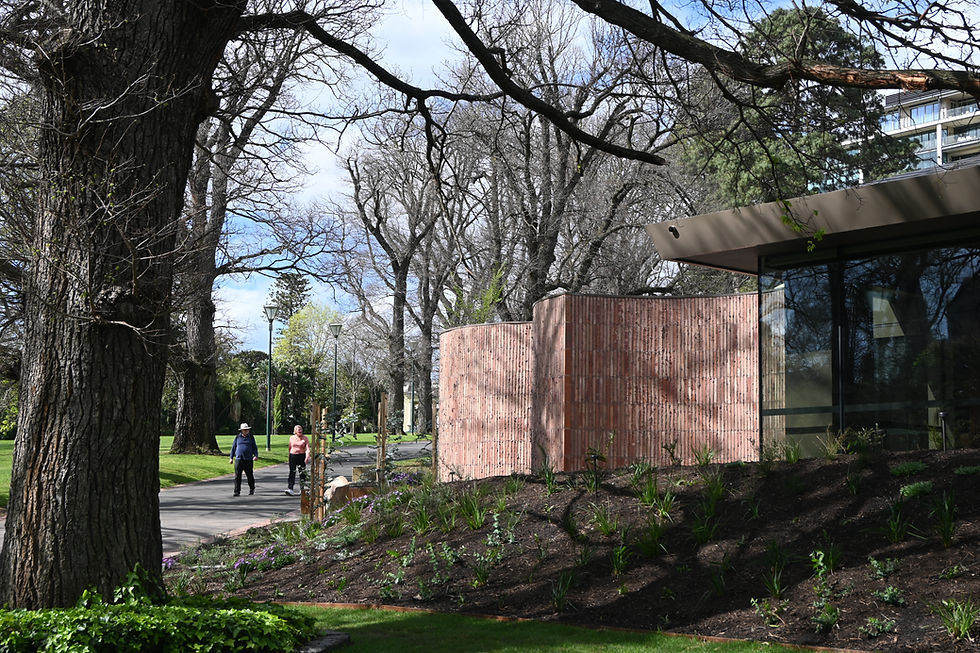
Yiaga is an indigenous word meaning to seek and find and from my own experience it became clear that the name was also related to journey into the site. Upon my arrival from Clarendon St and Wellington Parade intersection I wandered down the paths of Fitzroy Gardens until I saw the project emerge from the tree lined paths. The project is characterised by a subtle dark pyramidal roof form, and sweeping curves of the terracotta brick walls and their oozing mortar joints. “The name was influential through the restaurant before finding your table, it became an extension of that journey to that point of interaction with him with his food.”

On the siting and location of the new restaurant John says that Yiaga “couldn't be anywhere else.” Sited in the historic Fitzroy Garden, on the site of two previous pavilions, one that burnt down in the 1960s, and the one that was built soon after. John described them as “a rather humdrum affair, but with one kind of redeeming feature.” The former Pavillion black pyramidal shaped slate roof, and was retained as a device to register place. In John’s words:
“The old pavilion was poorly placed and created an armature around a great big red brick retaining wall and a sea of brick paving. They seemed to separate it from the gardens. So the first thing I suggested was to break down the wall, remove it completely, and have a sweep of the gardens up into this shifted topography up right up hard into the glazed edge of the restaurant. And that way, it sort of places itself as an element of the gardens, much more strongly. And from there, we came together everything that he was interested in beyond, beyond but related to food, all the vessels that would contain food, the glassware, the cutlery, the amazing array of crockery, and sought different people to come together to make this incredible array of items that he would prepare his dishes around, pretty often the shape and form of a dish actually either dictated the making of an object or was influenced by the form of an object in the way it's presented at the table.”

John says that a good example of the artefacts that are emblematic and record all of those characteristics of a particular place, community, and time is Yiaga. The collaboration between John, Hugh and their teams with many highly skilled artisans from around Australia worked alongside Hugh’s culinary ambitions and philosophies for a completely local food experience. John describes the collaboration as having offered one of his greatest passions to the success of the project, his deep appreciation of others of particular skills, technical and creative skills.
“From my side, I brought together many of the constructed elements the terracotta made in Melbourne, a bit like food miles with cooking. We sort of looked at that, so other than some things that slipped across the border to South Australia or down across Bass Strait to Tasmania, and most everything else was made either in Melbourne or Victoria. So an amazing array of ceramicists from Victoria and Tasmania, knifemakers from Tasmania. chairs made by an amazing chairmaker, Jon Goulder in Adelaide. The glasses were made at the jam factory in Adelaide. I particularly the long in orchestrated other smaller and very often young makers that made the collabor, the private dining room table that you'll see, an amazing light fitting that sits over the top of it and other things that I've then kind of shared or expanded the potential commission to include a broader array of makers that have come together.”
Almost every element of the project is bespoke. From the table chairs, the custom blown glass light fixtures, and the Yiaga’s own craft beer. All were designed for this restaurant, which is what makes this project truly local and perhaps its greatest strength.
Central to Wardle’s design philosophy is celebrating craftspeople. John says local craft is important to him because it “places us within time and records so many things.”
"We often have quite a degree of accuracy. We can search the world over and find objects that have been made at a particular place. The thing that I always find fascinating is that they record the moments in time. The technologies available, the cultural imperatives that might have drawn a community together, the geographical influences, was there clay in the ground, or to be produced or something that drew people to get that really actually sort of crafted the fabric of a society, and many of those things then produce artefacts that are emblematic and record all of those characteristics of a particular place community, and time.”
This design philosophy has shaped many projects across John’s career, Wardle's practice and a key part of the practice’s point of difference.
“Architects can often let their anxieties of gaining a commission, in that they are hard to gain and we will forever be competing for them, often turn inwards and try to do everything themselves. I've generally had this idea of how I can expand the potential of a commission by including somebody else, and very often victuring into the art community or the maker's community to explore areas of the narrative that I think can be extended beyond architecture.”
We asked John whether the project changed course as a result of the makers and collaborators. He was adamant that they didn't but rather that they still added momentum to it.
“I was intent on using terra cotta. It has a particular range of characteristics that I enjoy. Other than timber, it is possibly the most universal material on the planet. You'll see references of this also to the beach house I designed for our family, which is called Burnt Earth. Now that we have to be much more careful of the use of timber, we used timber. In the past timber was a central material in so much of our work, and now we still use it but in a much more defined code of conduct. Generally when we can, we use recycled timber flooring and new timber in windows for durability, but it is a precious primary commodity. Timber does not seem to have the same universality that brick has. It has a warmth and obviously an earthiness, so something that is acceptable to a broad range of people.”

John’s reflection on the design process behind the project was curious, but not surprising given his love for raw and local materials; it started with John attending the site and scraping back the earth of gardens to reveal the earth below.
“I thought to build it out of earth itself was a good thing. So outside, bricks made by Krauss family brickworks in Central Victoria are laid vertically and have an oozing mortar joint. It has the texture of the Fern Gully trees that surround them. The pattern and the things that we register are significant to that place and the elms of the primary trees are echoed in our cladding system of these vertical vertically laid stretcher bond bricks on the exterior. And then interior, you actually are completely immersed in terrarotto. And the moment you open the front door through two separate chambers before you' even arrive in the dining path. So you're immersed in this material, and then it backgrounds virtually every line alignment with the centre of the plan as you then sort of inhabit the wall, or many of the people inhabit the wall and then look out into the garden. So it becomes the primary architectural expression of the interior. Beautiful. And I guess in terms of the very local and remarkable cuisine that they're serving at this restaurant”
Hugo Simoes Santos, General Manager of Yiaga, who was also a crucial part of shaping the design brief of Yiaga, admits that the dishes were the last ingredient for this project.
“It’s been over 5 years we’ve been designing, but the food was the last thing. The focus for us has been on designing the feeling, the culture, and what the restaurant will represent. The Chefs have only been working on the dishes for the past 6 months. We are much more focussed on how the guests feel in the restaurant. Our focus was to make sure there are no bad tables. Every table has something special within a space that has been designed with purpose.”
A passion project of John’s that has culminated in his residency in East Melbourne, and Hugo says he is on “speed dial for any cancellations.”

-
Interview Credits:
John Wardle and Hugo Simoes Santos interviewed by Isabella Paola-Rose Etna
-
Project credits:
Wardle
Year: 2025
Project concept sketches and orthographic drawings provided by Wardle
Project photos by Isabella Etna


Comments