
Opinion 19: The Second Ecology
Updated: Feb 13
Ecosystems Above the City
By Darcy Jane Resch
As we enter the second quarter of the 21st century, cities are shifting toward a new ecological paradigm. Cities are no longer sites of purely human ambition, but dynamic terrains in which ecological entanglement is paramount. Rising populations, taller skylines, and accelerating climate change demand that urban environments become not only habitable for humans but also resilient habitats for non-humans. In cities, rooftops are among the most overlooked resources and should be reimagined as ecological corridors that sustain biodiversity. By challenging anthropocentrism, rooftops can evolve from neglected slabs into living infrastructures that nurture pollinators, cool overheated cities, and support a shared future across species.
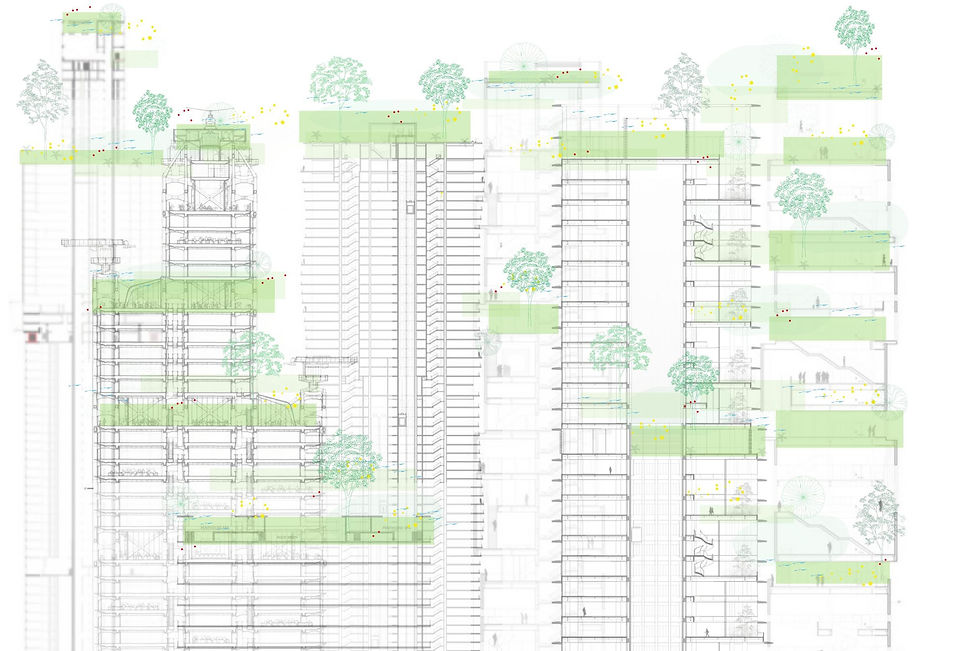
Flat roofs cover endless hectares, yet they remain dominated by HVAC units, solar panels, and water tanks, concealed. These surfaces should instead serve as vital ecosystems, stitching fragmented habitats into networks. The theory of ‘patch dynamics’ provides a framework for this rethinking, where ecosystems are conceived of as mosaics of interconnected cells. Applied to Melbourne, it suggests that rooftop gardens, apiaries, and pollinator habitats must not remain isolated interventions but rather function as continuous green corridors woven through our urban fabric. As Anna Tsing observes in the Field Guide to the Patchy Anthropocene and the Feral Atlas, patchy environments embody resilience, offering spaces where non-human life forms can live amid fragmentation.
The Bees
The scale of Melbourne’s urban beekeeping is already immense, a movement to which Barry Cooper of the Melbourne Beekeepers Club belongs. In conversation with Mr. Cooper, he estimated that there are more than 20,000 hives across the city. He explained to me that for bees, ground-level and rooftop hives are functionally the same, but their survival depends on thoughtful design. Cooper stresses that rooftops can become resilient micro-ecosystems if they are designed correctly. They should include reliable water sources, each hive needs more than a liter daily, and wind breaks to help bees navigate at high elevations, rooftop to rooftop. Design elements, such as rooftop water sources, illustrate how architecture can actively support pollinator health and, by extension, the broader web of species that depend on them.

However, not all rooftops are equally viable. Mary Trumble of Backyard Honey cautions me that bees haven’t done well on Melbourne rooftops. In Melbourne’s Central Business District (CBD), many rooftop hives fail because there are not enough pollinator-friendly flowers to sustain them, and bees waste enormous energy flying to the tops of tall buildings. Bees can travel up to five kilometers to source nectar, though some believe that bees in urban colonies may travel much shorter distances, extending their lives and increasing honey production. Yet this benefit only holds true if there are enough flowers available in the urban core; without them, bees expend even more energy, a futile path that humans led them down. Mary is sharp in her observation that, without adequate planting, rooftop hives are destined to fail.
Mary, a wealth of knowledge, argues that the most effective intervention designers can advocate for is planting urban gardens rich with pollen. She is enthusiastic about “getting comfortable with the ugly and embracing the weeds” as a way to create the most abundant pollinator-friendly gardens. She explains that healthy bee populations require three elements: abundant pollinator-friendly planting, third parties to maintain hives and educate communities, and councils committed to biodiversity planning and green space requirements.
These non-physical elements echo the idea of patch dynamics. Working parts coming together to create a stronger, more resilient, whole. If one cell is removed, all the cells are weaker. Designers should more often put themselves in the mindset of biologists, animal advocates, and gardeners, and view bees as vital components of each ecosystem. Golden like the sun, bees bring life. If an architect wouldn’t build without windows, why would they build without bees?
The city itself could transform into a vertical meadow. Imagine bees flying laterally from roof to roof, not needing to expend energy to descend to ground level. Elevated habitats would hold the abundance they need, allowing them to live and forage within our skyline. This vision positions rooftops as a parallel ecology, one that mirrors the forests and fields lost beneath concrete. Adopted at scale, such a system could bring cities to life, with bees at its center, carrying pollen, making their honey, and sustaining biodiversity.
The Patches
Research shows that insect and animal diversity broadly declines with urban density and habitat loss, but connectivity between green spaces can counteract these effects (Collins et al., 2024). Roads and walls act as barriers, but roof gardens, elevated above barriers, stitched into networks, would allow birds, bugs, and bees to live and thrive within fragmented landscapes. Rooftop ecosystems, if thoughtfully designed, could function as the connective tissue for urban biodiversity.

Patch dynamics not only views ecological systems as mosaics but also emphasises the importance of movement across those patches. In fragmented landscapes, survival often depends on how easily species can travel between resource-rich zones. For bees, this means that isolated rooftop gardens are insufficient; what matters is how they connect into a continuous sequence of patches. If designers coordinate across the skyline, rooftops could serve as stepping-stones in an aerial corridor, each cell offering pollen, nectar, and water in sync. A hive on one roof would no longer be cut off by roads and towers below, but instead linked to a chain of life above the city, the Second Ecology.
Ethnographic research reminds us that bees are not passive laborers but active participants in our city life. Their labor is not separate from ours but interwoven with it, an inter-species collaboration within shared urban space. Moore and Kosut (2014) describe them as “non-human informants,” shaping and being shaped by our urban environments. They occupy what the authors call “contact zones,” where human and non-human lives intersect. Bees remind us that the city is not ours alone but a choreography of many lives. However, the built city rarely fosters healthy cohabitation on its own; it is up to us to create it.
To watch a bee at work is to witness tenderness in motion, a reminder that beauty is not just found in grand gestures but in the small, steady acts that keep a world alive. The designer is first an observer, a researcher, and an interviewer. What would a bee tell you in a conversation? They may tell you that each hum is a promise of hard work and of their return. They may say that their hive’s rhythm will keep life pulsing in the corners of our rooftops. It is the role of the architect to listen to the often-unheard and to recognise the significance of their presence and influence.
As Melbourne continues to densify, rooftops emerge as one of the city’s most powerful yet underused ecological assets. With coordinated planning, these elevated surfaces could link together into continuous habitats stretched across the skyline. Constantinos Doxiadis, in his theory of Ekistics, called for urbanism to adopt its own scientific language, comparable to biology, to systematically understand and coordinate interventions. Without such frameworks, sustainability efforts remain fragmented and symbolic. A “Second Ecology” of the urban rooftop ecosystem can only emerge if designers critically assess and communicate the cumulative impact of their interventions through a green rooftop typology.
The Call
At Woodleigh School Senior Campus in Langwarrin South, architects Main and Frank planted indigenous grass on the rooftop to create a pollinator habitat. Rabbits had eaten these species when planted at ground level, but on the roof, they thrive while also sustaining bees and butterflies. “The biodiversity crisis is as bad as the climate crisis,” architect Frank Burridge warns me, situating his practice with ecological urgency.
Burridge elaborates on the architectural system: “The green roof is a wicking bed system, retaining rainwater in the base that is available for plants to 'wick' up using capillary action. This allows the plants to draw water as needed, i.e., the system uses nature's principles to customise the rate of water flowing up into the soil to suit each plant. This makes it very drought resilient and low maintenance (it is not an irrigated roof). The design has meant that many species of indigenous grass that are difficult to grow have been able to thrive on the roof. I think there are some ducks nesting up there now, too.” His description highlights how researching architectural systems can enable ecological resilience once built, transforming a school rooftop into a thriving refuge.

The Woodleigh example reflects a broader shift, as many design firms now integrate research into interdisciplinary practice. Deep Design Lab points to what is possible when design, ecology, and evidence-based practice converge. Their speculative research projects combine ecological science with computational modeling and prototype installations, showing how urban systems might adapt dynamically to support both humans and non-humans. Their projects, worth exploring, demonstrate that architectural practice can be more than responsive; it can actively cultivate multispecies cohabitation.
Architects should welcome the challenge of ecological and non-human research to support concept design. Kallipoliti (2024) situates this within the “Nonhuman Turn,” a philosophical and design shift that destabilises human-centered traditions in favor of multispecies cohabitation. However, it is crucial to understand that supporting non-humans enriches human life. Thriving ecosystems strengthen human health, and resilient urban bees transform cities into living, breathing environments.
Posthumanist design reminds us that the well-being of plants and animals is inseparable from our own. By embedding ecological intelligence as the core concept of urban forms, rooftops can evolve into networks of biodiversity that counterbalance the scale of urbanism. Bees remind us that thriving urban futures do not belong to humans alone. The sooner we cultivate an interconnected ecological rooftop system, the stronger our collective resilience will become.
Design should be a humanitarian act, one that must advocate for all plants, non-humans, and humans. My commitment is to use architecture as a means of cultivating healthy life across and between species. I aim to live and create a world of abundances, not scarcities. Bees remind us that change can be as small as a grain of pollen, carried from one flower to the next. Rooftop ecosystems working together can bring about this new ecological paradigm.
-
References:
Collins, C. M., Audusseau, H., Hassall, C., Keyghobadi, N., Sinu, P. A., & Saunders, M. E. (2024). Insect ecology and conservation in urban areas: An overview of knowledge and needs. Insect Conservation and Diversity, 17(2), 169–181. https://doi.org/10.1111/icad.12733
Doxiadis, C. A. (1968). Ekistics: An introduction to the science of human settlements. Oxford University Press.
Doxiadis, C. A. (1977). Ecology and ekistics. Hutchinson & Co.
Dramstad, W. E., Olson, J. D., & Forman, R. T. T. (1996). Landscape ecology principles. In Landscape ecology principles in landscape architecture and land-use planning (pp. 19–46). Island Press.
Hyde, R. (2013, August 29). Melbourne honey bees. ArchitectureAU. https://architectureau.com/articles/melbourne-honey-bees/
Kallipoliti, L. (2024). Non-humans. In Histories of ecological design: An unfinished cyclopedia (pp. 207–213). Actar Publishers.
Kirk, H., Smith, T., Backstrom, A., Morán-Ordóñez, A., Garrard, G. E., et al. (2017). Our city’s little gems: Butterfly diversity and flower-butterfly interactions in the City of Melbourne. Report prepared for the City of Melbourne. RMIT University.
Main Studio. (n.d.). Main. Retrieved September 28, 2025, from https://main-studio.com/
Mata, L., Ives, C. D., Morán-Ordóñez, A., Garrard, G. E., Gordon, A., et al. (2016). The little things that run the city: Insect ecology, biodiversity and conservation in the City of Melbourne. Report prepared for the City of Melbourne. RMIT University.
Moore, L. J., & Kosut, M. (2014). Among the colony: Ethnographic fieldwork, urban bees and intra-species mindfulness. Ethnography, 15(4), 516–539. https://doi.org/10.1177/1466138113505022
Stanford University. (n.d.). Feral atlas: The more-than-human anthropocene. Stanford University Press. Retrieved September 28, 2025, from https://feralatlas.supdigital.org/?cd=true
The Theory of Architecture. (2023, May 18). Podcast [Video]. YouTube. https://youtu.be/W88ZnWBdUow?si=SGgIbk37PPHYuJrt
Wiki.DeepDesignLab. (n.d.). Deep Design Lab wiki. Retrieved September 28, 2025, from https://wiki.deepdesignlab.online/
-
Darcy Resch is a dedicated and hardcore Master of Architecture student at the University of Melbourne who loves to speculate on the future of design and culture. Drawing on her background in fine woodworking and furniture design, she approaches architecture through research. She is an aspiring academic, interested in postmaterialism and striving for a future PhD.
Outside of architecture school, she writes for the non-profit organization The Furniture Society and creates independent zines, including The Short Guide to the History of Furniture, Temporary Architecture as Positive Interventions for Stronger Cities, and What is Neuroarchitecture and the Women Researching It. Her newest research and writing endeavor is a literature review and theorization of Architectural Sympathy.


Comments